Muse of Arcana • Cartomantic Archaeology & Lost Origins
The Mamluk Cards of Egypt: Ancient Symbols, Sultanate Craft & The Road to Europe
Before Renaissance triumph cards and modern Tarot decks took shape, Islamic Mamluk playing cards carried intricate calligraphy, geometric ornament, and courtly ranks across the Mediterranean—leaving behind an unexpected blueprint for European card history.
Before Tarot ever became a set of illustrated triumph cards in fifteenth-century Italy, card decks already existed in the Islamic world—and among the most remarkable surviving examples are the Mamluk playing cards from the Mamluk Sultanate of Egypt (spanning roughly the thirteenth to early sixteenth centuries, with the best-known surviving fragment dated to around the late fourteenth or fifteenth century).
For anyone fascinated by cards, symbols, and esoteric history, the Mamluk deck is a revelation. It strips away later European allegorical layers and lets us look directly at an older, aristocratic paper-card tradition built on ornamental geometry, poetic Arabic inscriptions, and courtly rank rather than human portraits.
Historical Roots: The Mamluk Sultanate & Early Paper Cards
Paper-making had reached the Islamic world centuries earlier, and by the late medieval period, Cairo and other centers of the Mamluk realm were vibrant hubs of craft, book arts, calligraphy, and trade. Paper cards were lightweight, portable, and suited to both lively social games and refined courtly pastimes.
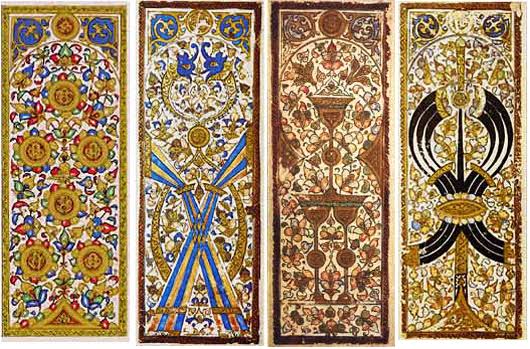
Because Mamluk society operated under Islamic artistic norms that generally avoided figurative depictions of living beings in sacred or prestigious ornamental arts, Mamluk card makers achieved visual brilliance through arabesques, floral scrolls, medallions, and calligraphic epigraphy. The cards felt closer to illuminated manuscripts and metalwork than to modern illustrated picture decks.
- Material & Craft: Early Mamluk cards were crafted from laminated layers of paper—often stiffened and polished—giving them durability while keeping them light in the hand.
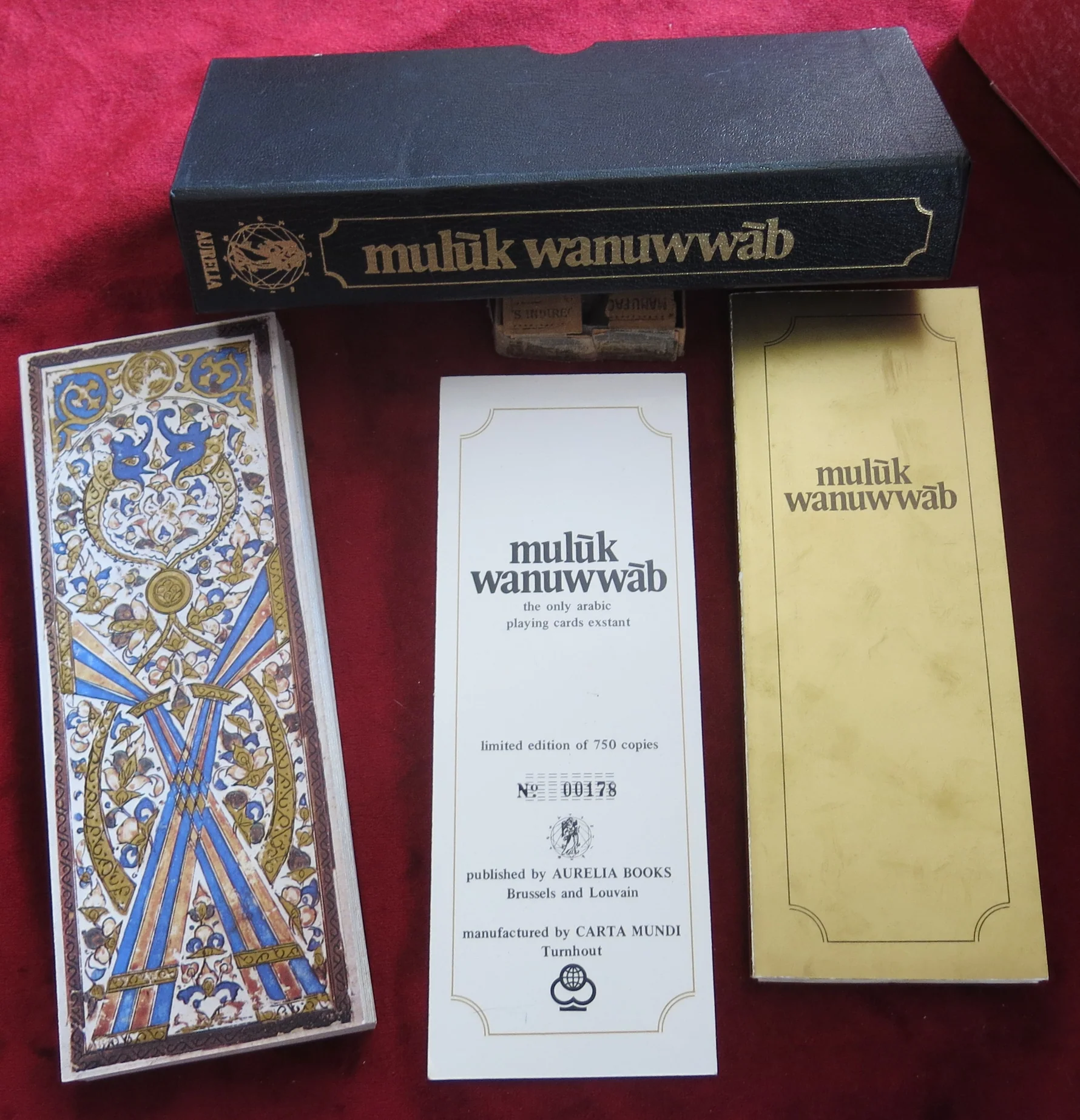
- The Topkapi Fragment: The most famous surviving Mamluk deck fragment (preserved in Istanbul’s Topkapi Palace collection) preserves dozens of cards from a larger set, offering rare direct evidence of their design and structure.
- Courtly & Social Life: Card games moved through bustling urban spaces and aristocratic circles alike, blending competition, chance, and wit.
Did you know? Unlike modern playing cards where only a few court cards carry titles or mottos, Mamluk cards often featured rhyming poetic phrases or courtly inscriptions that turned each card into a miniature literary epigram.
Calligraphy, Rhyming Verse & Courtly Poetics
What makes Mamluk cards feel uniquely refined is the interplay between visual geometry and spoken word. Rather than relying on human faces or scenes, the card faces organized emblems inside decorative cartouches, roundels, and foliate borders, accompanied by crisp calligraphic script.
- Poetic Inscriptions: Short, rhythmic or rhyming lines addressed the player or celebrated royal dignity, turning a trick-taking game into an encounter with courtly wit and refined etiquette.
- Visual Symmetry & Rhythm: Repeating motifs—whether swirling arabesques, lotus/floral medallions, or balanced arrangements of blades and goblets—gave each rank a distinct visual cadence at a glance.
- Aesthetic Continuity With Manuscript Art: The same sensibility that elevated Mamluk Qur’an bindings, brass inlay trays, and glass mosque lamps shaped these compact paper artifacts.
How Mamluk Symbols Looked Before European Adaptation
One of the most compelling parts of studying Mamluk cards is seeing the original suits and court hierarchy before Europeans reshaped them. A Mamluk deck organized its numbered cards into four suits, each paired with a distinct courtly rank structure:
- Coins (Darahim / Gold or Silver Discs): Rendered as ornate circular medallions or discs filled with intricate geometric stars, rosettes, and arabesque patterns—visual cousins to coins, trade wealth, and circular medallions.
- Cups (Tuman / Goblets or Chalices): Depicted as graceful, footed ceremonial cups or goblets with delicate stems and floral ornament rather than simple domestic mugs.
- Swords (Suyuf / Scimitars or Curved Blades): Drawn as curved or stylized blades arranged rhythmically across the card face, echoing martial prestige and sharpness.
- Polo Sticks (Jawkan / Mallet-Sticks): A signature Mamluk suit! Polo was a prestigious royal and military sport among the Mamluk elite, so the curved polo stick (jawkan) stood as an unmistakable emblem of courtly skill and noble play.
Even the court hierarchy had its own distinct voice. Instead of the later European Page, Knight, Queen, and King, Mamluk decks featured high courtly titles such as Malik (King or Sovereign), Na’ib Malik (Viceroy or Deputy King), and Thani Na’ib (Second Deputy), followed by the numbered cards from ten down to one.
Symbol Shift Note: When Europeans adapted four-suit decks, the Mamluk polo stick (jawkan) transformed into what became batons, clubs, or wands—a vivid example of how a culturally specific aristocratic symbol gets translated into a visual form familiar to a new region.
How Mamluk Cards Reached Europe
The Mediterranean has never been a closed wall; it has always been a sea of merchants, sailors, diplomats, pilgrims, and artisans. Through bustling trade routes linking Egypt, the Levant, and Italian maritime republics (such as Venice and Genoa), Mamluk cards traveled into Southern Europe—likely by the late fourteenth century.
European makers did not simply copy the cards blindly; they adapted them to local tastes, printing methods, and cultural imagery:
- Trade & Cultural Exchange: Port cities connected Islamic craft workshops with European markets, allowing card games and four-suit layouts to cross cultural borders rapidly.
- Translating Unknown Motifs: Calligraphic inscriptions and courtly polo sticks meant little to players who did not read Arabic or play Mamluk polo, so European artists reinterpreted the suits into coins/pentacles, cups, swords, and batons/wands.
- Adapting Court Ranks: Titles like Malik and his deputies were translated into European courtly and chivalric figures suited to local social hierarchies.
The Transition Into Italian Decks & Tarocchi
Once the four-suit card game took root in Italy—where cards were early on known by terms such as naibi—local craftsmen and court painters began weaving it into Renaissance visual culture. Over time, two parallel branches emerged from this shared heritage:
- Standard Latin-Suited Decks: Four-suit decks (coins, cups, swords, batons) continued as everyday playing cards across Italian regions and Spain, eventually giving rise to other regional suit systems across Europe.
- Triumph Cards & Early Tarocchi: In fifteenth-century Northern Italy, decks were expanded with a dedicated set of illustrated triumph cards (trionfi), blending trick-taking gameplay with Renaissance pageantry, virtues, and symbolic imagery—the historical threshold from which Tarocchi and later esoteric Tarot traditions grew.
Arcane Perspective: Tracing the journey from Mamluk medallions and polo sticks to Italian trionfi and modern Tarot reveals how symbols travel like living seeds: the outer costume changes across centuries and borders, while themes of power, wealth, conflict, desire, and transformation keep echoing.
Why the Mamluk Deck Still Matters to Esoteric & Card Lore
Looking back at the Mamluk cards adds rare historical depth to how we view cards today. It reminds us that symbolic systems are living lineages shaped by travel, translation, and human imagination.
In esoteric and contemplative practice, knowing this lineage keeps us grounded and curious: the suits of Cups, Swords, Coins/Pentacles, and Wands/Batons carry echoes of ancient trade, courtly rivalry, geometric harmony, and cross-cultural memory—long before modern decks gave them their current faces.